By Emily Ransome-Farmer MTPI AssocRICS, Head of Property Management at Watsons Property

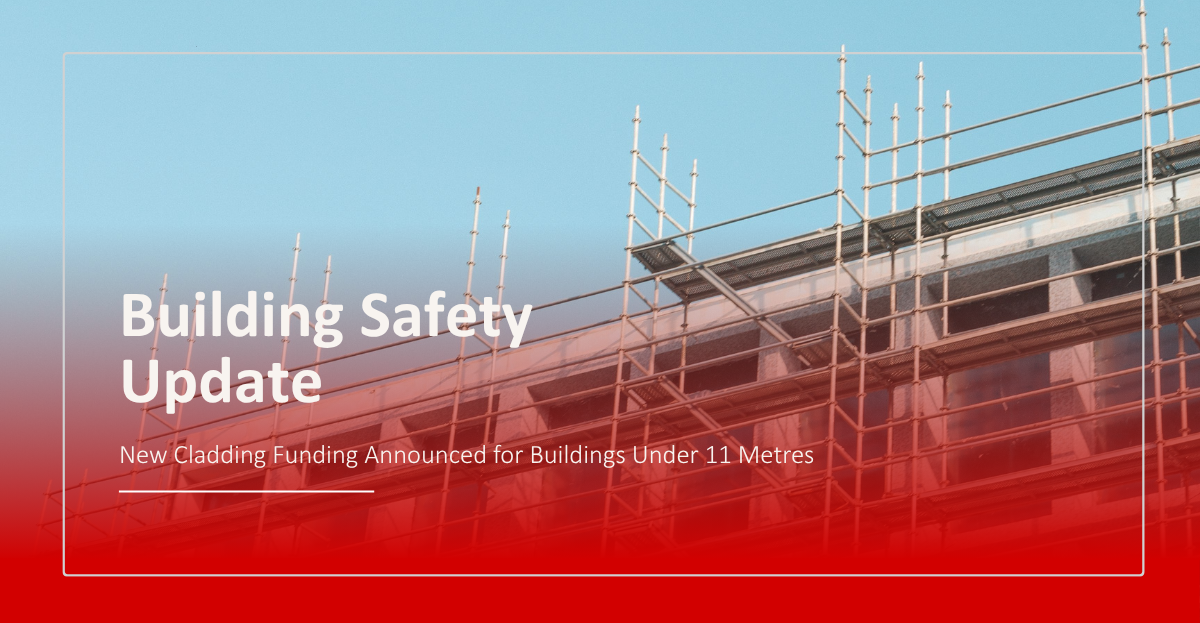
New Cladding Funding for Buildings Under 11 Metres: What You Need to Know
For several years, 11 metres was more than a measurement in the cladding-remediation landscape. It was a dividing line.
That line has now moved.
On 9 July 2026, the Government announced new funding through the Cladding Safety Scheme for certain multi-occupied residential buildings under 11 metres in England. The change creates a potential route to support for some lower-rise buildings affected by unsafe cladding, with applications assessed according to fire safety risk rather than height alone.
It does not mean that every building under 11 metres will qualify. Nor does meeting the published criteria guarantee that funding will be awarded.
For responsible entities, the immediate task is therefore not to assume eligibility. It is to understand the criteria, review the evidence already available and prepare for a relatively short application window.
What has changed?
The new funding removes the previous minimum-height requirement for this part of the Cladding Safety Scheme.
Funding may be considered for multi-occupied residential buildings under 11 metres in England where a Fire Risk Appraisal of External Walls — commonly known as a FRAEW — identifies a high or medium: action required cladding fire safety outcome and demonstrates that remediation or mitigation is necessary and proportionate.
The approach is deliberately risk based.
Buildings assessed as presenting a high cladding fire safety risk will be considered first. Buildings with a medium: action required outcome may be considered where funding remains after higher-risk cases have been addressed.
This is an important distinction. Removing the height threshold widens access to the scheme, but it does not create automatic eligibility for every lower-rise building with cladding.
At a glance
Applications open: 17 August 2026
Application window: Eight weeks
Who can apply: Responsible entities or authorised representatives
Key evidence: A PAS 9980:2022 FRAEW
Important point: Funding is risk-based and not automatic
Who can apply?
Applications must be made by the person or organisation with legal responsibility for managing fire safety at the building — referred to in the guidance as the responsible entity — or by an authorised representative acting on its behalf.
Depending on the ownership and management structure, the responsible entity may be:
- the freeholder;
- a head leaseholder;
- a registered provider of social housing.
A responsible entity may appoint a managing agent to make or lead an application on its behalf. However, responsibility for identifying, assessing and managing fire safety risks remains with the responsible entity.
Leaseholders and residents cannot apply directly. Anyone concerned about their building should contact the responsible entity first and ask who is leading the process, whether an application is being considered and how updates will be communicated.
What evidence will be required?
A funding application cannot be submitted without a FRAEW. A current Fire Risk Assessment should also be provided where one is available.
The FRAEW must be completed by a suitably qualified competent professional using the PAS 9980:2022 methodology. It assesses the risk of fire spreading through the external wall system and identifies whether remedial or mitigating action is required.
Homes England will review and audit the FRAEW and supporting information to determine whether the proposed measures are necessary and proportionate.
Responsible entities should also expect to bring together information about:
- the building;
- the responsible entity and its authority to act;
- relevant fire safety assessments;
- the identified risk outcome;
- any proposed remediation or mitigation;
- communication with leaseholders and residents;
- other funding or redress routes already explored.
Homes England may ask what action has been taken to pursue alternatives such as developer contributions, insurance claims or warranty arrangements before funding is confirmed.
Important dates
The new funding was announced on:
9 July 2026
Applications are due to open on:
17 August 2026
The application window will remain open for:
Eight weeks
There will be no pre-registration or early-access period. Valid high-risk applications will be date- and time-stamped and progressed in the order in which they are received.
The published guidance also states that cladding remediation will not be funded retrospectively where work had already started, or a binding contract had been signed, before the announcement on 9 July 2026.
Responsible entities considering new contractual commitments should review the current scheme guidance carefully and obtain appropriate professional advice before proceeding.
What should responsible entities consider doing now?
The period before applications open gives responsible entities an opportunity to establish what evidence is already available and where further work may be needed.
Confirm who is responsible
Identify the responsible entity and nominate a clear lead for the application process.
Where a managing agent or another representative may be involved, establish the scope of their authority and who will remain responsible for key decisions.
Review the available fire safety evidence
Confirm whether a suitable FRAEW has already been completed and whether a current Fire Risk Assessment is available.
Where assessments already exist, review:
- the stated risk outcome;
- any recommended remediation or mitigation;
- whether the findings remain current;
- whether the supporting information is complete.
The existence of cladding alone does not establish eligibility. The relevant fire safety risk and the need for proportionate action must be supported by the appropriate assessment.
Bring the supporting information together
Collate the relevant building information, fire safety records, evidence of authority and resident communications before the application window opens.
The Government guidance states that applications must be made through the Building Remediation Hub and cannot be submitted without the required FRAEW.
Record other routes already explored
Keep a clear record of contact with developers, insurers, warranty providers or other parties from whom a contribution may be available.
This may include correspondence, the outcome of claims, legal or contractual information and a record of the action already taken.
Keep leaseholders and residents informed
Responsible entities are expected to provide clear updates about assessments, identified risks, planned action and the progress of any funding application.
Communication is particularly important while information is still being gathered. Explaining what is known, what remains under review and what happens next can help reduce uncertainty without creating the impression that eligibility or funding has already been confirmed.
What can leaseholders and residents do?
Leaseholders and residents who are concerned about external-wall safety should contact the responsible entity in the first instance.
Useful questions may include:
- Has a FRAEW been completed?
- What risk outcome was identified?
- Is an application being considered?
- Who is leading the process?
- What information is still required?
- How will residents be kept informed?
Where residents experience difficulty engaging with the responsible entity, Homes England’s Tell Us Tool can be used to provide information about the building and any known safety concerns. Homes England may then follow up with the responsible entity.
The Tell Us Tool is not a direct funding application and does not replace the role of the responsible entity.
What the announcement does not mean
The new funding is an important development for some leaseholders and residents in lower-rise buildings who may previously have had limited access to remediation support.
But it is targeted funding, not an automatic entitlement.
The scheme has a fixed budget. Meeting the eligibility requirements does not guarantee an award, and some successful applications may receive only partial support where the available funding does not cover the full cost of the proposed work.
High-risk buildings will be considered first. Medium: action required cases will only be considered where funding remains.
The appropriate response is therefore a measured one:
Establish responsibility.
Review the evidence.
Prepare the required information.
Keep residents informed.
And avoid assuming either eligibility or funding before Homes England has completed its assessment.
Speak to our Block & Estate Management team
Building safety work can involve technical assessments, professional appointments, funding requirements and communication across several interested parties.
Where Watsons already manages your building, please contact your Property Manager to discuss the published guidance and the information currently held for your development.
For enquiries about our wider Block & Estate Management services, speak to our team.
Contact our Block & Estate Management team
Related reading: How Watsons supports buildings through the Cladding Safety Scheme